Alumni: Ben Lee
Thanks: This work is made possible by direct funding from the MIT Media Lab and
hardware contributions from Philips-Color Kinetics.
updated:
2012-02-10
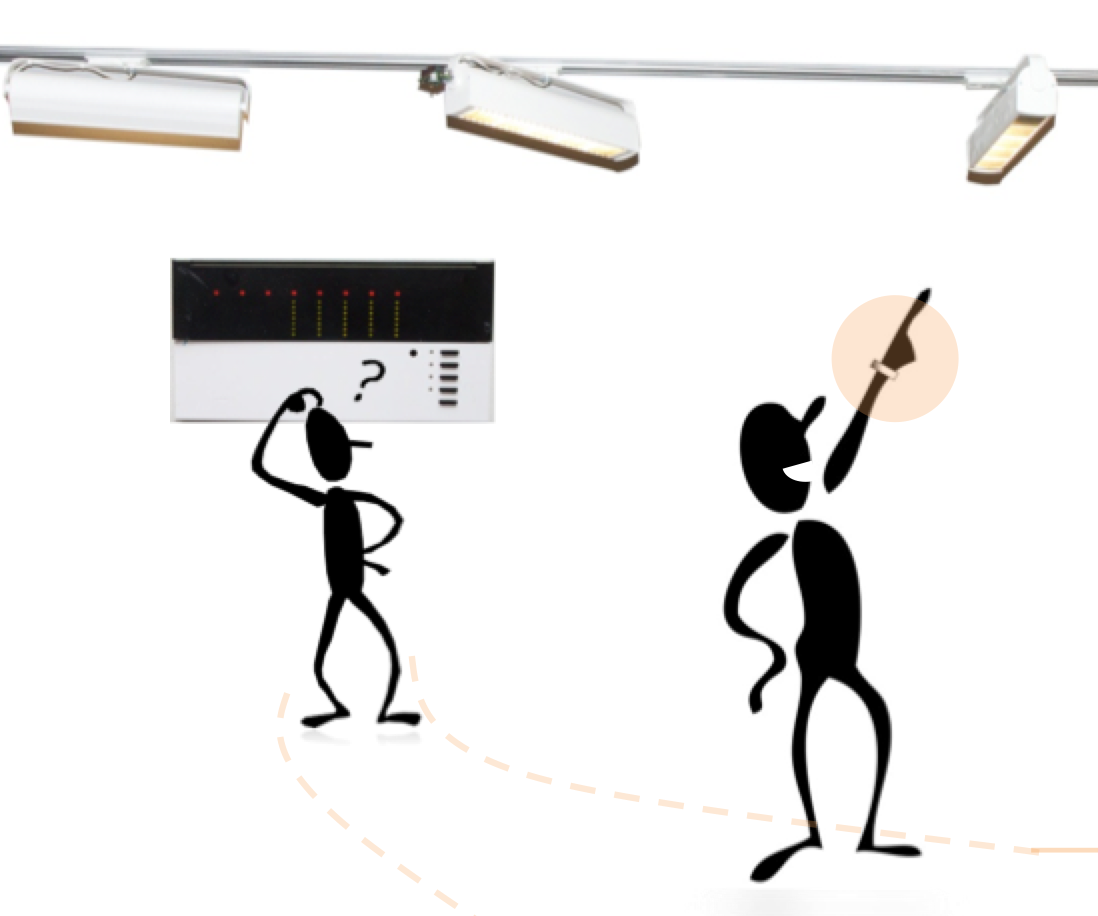
Occupants of near-future buildings will not necessarily be able to flip a
light switch or adjust a thermostat to control building utilities. There may
well be too many devices to easily control with direct "switches," and instead
they will need to be driven by inferred intention or simple, intuitive,
collective control. More crucially, as about 40% of the energy used in the US
and most developed economies tends to be consumed in homes and buildings [1],
energy conservation concerns will pull our hand off the dial as environments
will regulate themselves in order to accommodate occupants' objectives and best
tend to their comfort while minimizing energy consumption. Accordingly, smart
energy management will be a needed and motivating application area of
solid-state lighting, as user state, behavior and context are measured,
inferred, and leveraged across a variety of domains and environments using
sensors and actuators to mitigate energy usage.
Lighting, in particular, accounts for 22% of all electricity consumed in the
United States [2]. While simple motion sensors are now commonly integrated into
new buildings to turn lights off when occupants leave an illumined area, they
provide very coarse control input, often causing more area than is necessary to
be lit or mistakenly turning lights off when an occupant stays still for too
long. As we move into robustly sensed and finely actuated environments,
lighting will become richly responsive, dynamically adapting to users' needs
while mitigating energy use.
[1] U.S. Energy Information Administration., "Energy Consumption by Sector", Annual Energy Review, 2006 (2007).
[2] Navigent Consulting, Inc., "Solid-state lighting research and
development portfolio: Multi-year program plan fy'09-fy'15," tech. rep.,
Lighting Research and Development Building Technologies Program, Office of
Energy Efficiency and Renewable Energy, U.S. Dept. of Energy, Chicago
(2009).
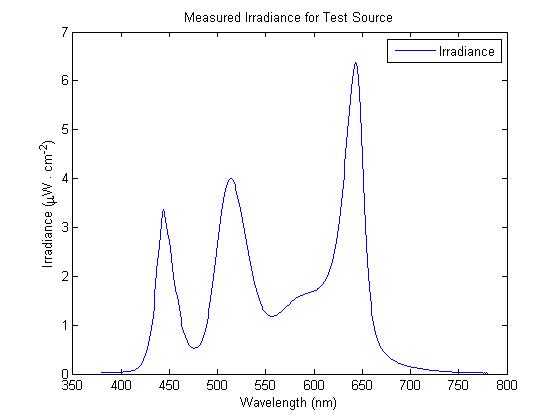
We have created a suite of MATLAB tools for calculating the lux and color rendering index of virtual and measured light sources. The scripts and documentation are hosted at Matlab Central.
News
Videos
Recent smart lighting demo at Ubicomp 2010 in Copenhagen.
The portable demo with two of four lights pictured and a control node (Ubicomp 2010, Copenhagen)

Controlling the two pentachromatic sources using the sensor node.
The phosphor-based lighting testbed.

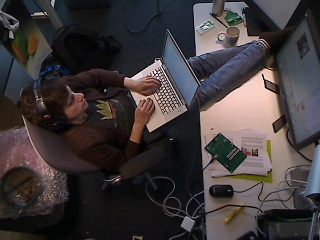
User working on the closed-loop phosphor-LED testbed.

Example five-wavelength LED array.

Debugging and testing of the sensor node prototype.
Lee, B., Aldrich, M., and Paradiso, J., "Methods for measuring work surface illuminance in adaptive solid state lighting networks ," Proc. SPIE 8123, 81230V (2011). http://dx.doi.org/10.1117/12.893562
Paradiso, J.A., Aldrich, M., Zhao, N., "Energy-efficient control of solid-state lighting ," SPIE Newsroom, March 25 2011. http://dx.doi.org/10.1117/12.860755
Aldrich, M., Zhao, N., and Paradiso, J., "Energy efficient control of polychromatic solid-state lighting using a sensor network," Proc. SPIE vol. 7784, 778408 (2010). http://dx.doi.org/10.1117/12.860755
Theses
Aldrich, M., Dynamic Solid State Lighting, Master's Thesis, Massachusetts Institute of Technology (2010).
Zhao, N., Smart
Solid-State Lighting Control, Diplom, RWTH Aachen University (2010).